Skip to content

Vizier

Free Download for PC · v1.1

Vizier
Platform
PC (Windows)
Release Date
File Size
2.54 GB
Views
23
Patch Notes
2
Comments
0
Languages
English, French, German, Spanish - Spain, Polish, Russian, Portuguese - Brazil
Added by
Skigameco Legend

Play modes & compatibility

  • Single-player
Download Game v1.1

Version Status

Current Version
v1.1
Current Build
26914858
Latest Build
26914858
Last Steam Update
Included DLC · 1
  • Vizier Demo
Rate & review
No ratings yet.
Steam
50%
6

Screenshots

Vizier — Screenshots 1
Vizier — Screenshots 2
Vizier — Screenshots 3
Vizier — Screenshots 4
Vizier — Screenshots 5
Vizier — Screenshots 6
Vizier — Screenshots 7
Vizier — Screenshots 8

Description

Whispering fatal advice into a young monarch's ear while rival nobles plot your downfall is the whole game in Vizier. Created and published by Verdigris, this single-player narrative strategy title drops you into a medieval royal court full of backstabbing, war, and shifting loyalties, much like the tense political balancing acts in Reigns or Crusader Kings. Scroll through the screenshots, gameplay videos, and PC system requirements on this page to preview its painterly portraits before taking your seat at the throne.

Instead of swinging swords on a battlefield, you shape the realm across turn-based seasons by building your custom advisor and weighing tough policy cards. Every decision shifts your reputation across traits like idealistic, harsh, just, or schemer while testing your survival over multi-year reigns and branching story arcs. The game runs on Windows PC and Steam Deck, includes 40 achievements, and supports full text in seven languages including English, Spanish, German, French, Polish, Russian, and Brazilian Portuguese.

Keep this hub bookmarked to check the latest patch notes and see what Verdigris is tuning next, from card text rewrites and faction balance to control improvements. Stop by whenever new updates arrive to track how court politics and performance fixes evolve.

System Requirements

Minimum

OS:
Windows 10 64-bit
Processor:
Any 64-bit dual-core, 2.0 GHz
RAM:
4 GB RAM
Graphics:
GPU with Vulkan 1.0 support (GeForce GTX 600 / Radeon HD 7000 / Intel HD 500 series or newer), 1 GB VRAM
Storage:
5 GB available space

Recommended

OS:
Windows 11 64-bit
Processor:
Any modern quad-core
RAM:
8 GB RAM
Graphics:
Any discrete GPU from 2018 or later, 2 GB VRAM
Storage:
5 GB available space

Installation Guide

Step-by-step setup process

  1. No installation is needed — the game comes fully pre-installed and ready to play.

  2. Extract the RAR / ZIP archive with WinRAR or 7-Zip into any folder, for example C:\Games\GameName.

  3. Launch the game via Run Me!.bat (or the main .exe file) inside the game folder.

Game Info

Developer
Verdigris
Publisher
Verdigris
Platform
PC (Windows)
Release Date
File Size
2.54 GB
Status
Not specified

Download Game

Full game

v1.1 2.54 GB Updated 5 hours ago
Download Vizier.rar.torrent

Torrent file ready

File checksums (MD5 / SHA-256)
MD5: 1f2fb6608e7000f8b33b5924011cfc6f
SHA-256: 061c48754d33cc8f9c212a398e5ef15237566138fb688831577514c2195bdd58

Checksums verify the integrity of this specific file. They are not an absolute malware guarantee — always scan downloaded files.

Patch Notes

Official changelists for the builds of this game

Update 1.1 — Eleven Court Scenes, the War Table, the Feast, and Audience Day

Current Build 26914858
Thank you for playing Vizier, and for the detailed reviews and letters since launch — many of the biggest additions in Update 1.1 grew directly out of them.

New 11

Eleven court activities as living scenes: across a service, key matters open into a painted scene of their own — the frontier signal fires on the ridge, the court's departed named by winter candlelight, a disputed boundary across the land, an investigation board, suspect coin and the touchstone, a cup and a bezoar, a lesson for the young heir, a cedar endowment model under the lamp, a name for a finished monument, a silent bargain over a knotted cord, and a diplomatic carpet for a neighbouring court. Your answer is a painted icon with its tone's seal, and the scene then plays out what you chose; in a few you also lend a hand — dropping the bezoar into the cup, rubbing the coins on the touchstone, moving a bead to a knot on the bargain's cord or choosing the carpet's wool, border and medallion.

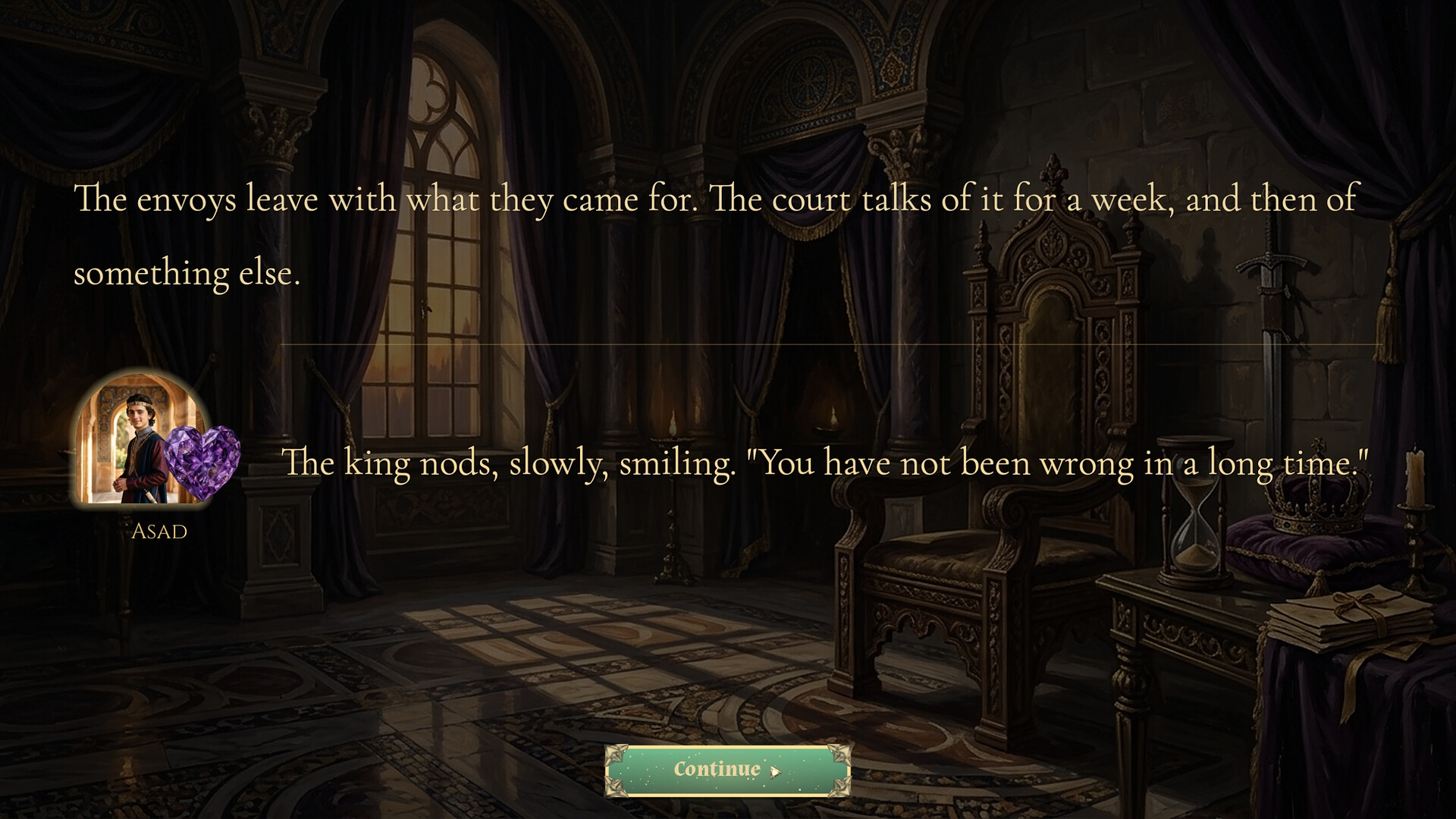
Confrontation before the king & the long council table: right after your first council the king seats you opposite the rival at his long table, and your first clash brings you face to face across the board. When your rival makes a decisive throw, it unfolds across three exchanges at the king's table — answer with a loyal faction, an uncovered secret, a thriving province, a known tone of the king's, gold, or a debt of honour while the king's expression shifts with the room. When a rival falls, their piece topples on the shatranj board; when a new rival is appointed, they enter the hall as the king himself names why he chose them.

Love that carries weight at court: a lasting bond now matters when your fate is on the line — at a confrontation before the king, your beloved can rise and speak for you (at the honest cost of a secret affair becoming known to the hall, or friction with the nobility in marriage). New scenes also bring «Two cloaks without a name» by the night river, «Answer with a gift» when you inspect your beloved's keepsake in The Vizier's Chambers, and a quiet farewell of its own if death parts you.

Feast seating: at court banquets you now seat four of up to six courtiers beside the king with your own hands. Whoever takes the seat of honour at the king's right shapes the evening by their strongest art, the left seat wins personal favour, friends placed side by side warm to you, foes placed together nurse a grudge, and the most prominent guest left at the lower tables remembers the slight unless they already owe you favour.

Audience day: three times a service, a person of the city comes to your door with a request and a drawn sheet you can inspect up close. Answer with your seal — grant it, refuse, or pass a quarrel to the judge — and hear each petitioner react in their own voice.

The War Table & War's End: campaigns now play out at the field table over the map, showing the strength of both hosts and what decides each clash, and conclude with a dedicated War's End painting and full reckoning of treasury, prestige, army, and tribute.

«Ride the Lands» & «A night in the city»: ride out from The Vizier's Desk to one or two provinces to test a governor's market weights on the bronze scales or bring back a gift of the land; and three times a service, walk the night street with a single lantern, choosing two of three doors where named townsfolk tell you before dawn what reproach is being whispered against you at court, how your uneasiest province fares, or what your coldest neighbour intends.

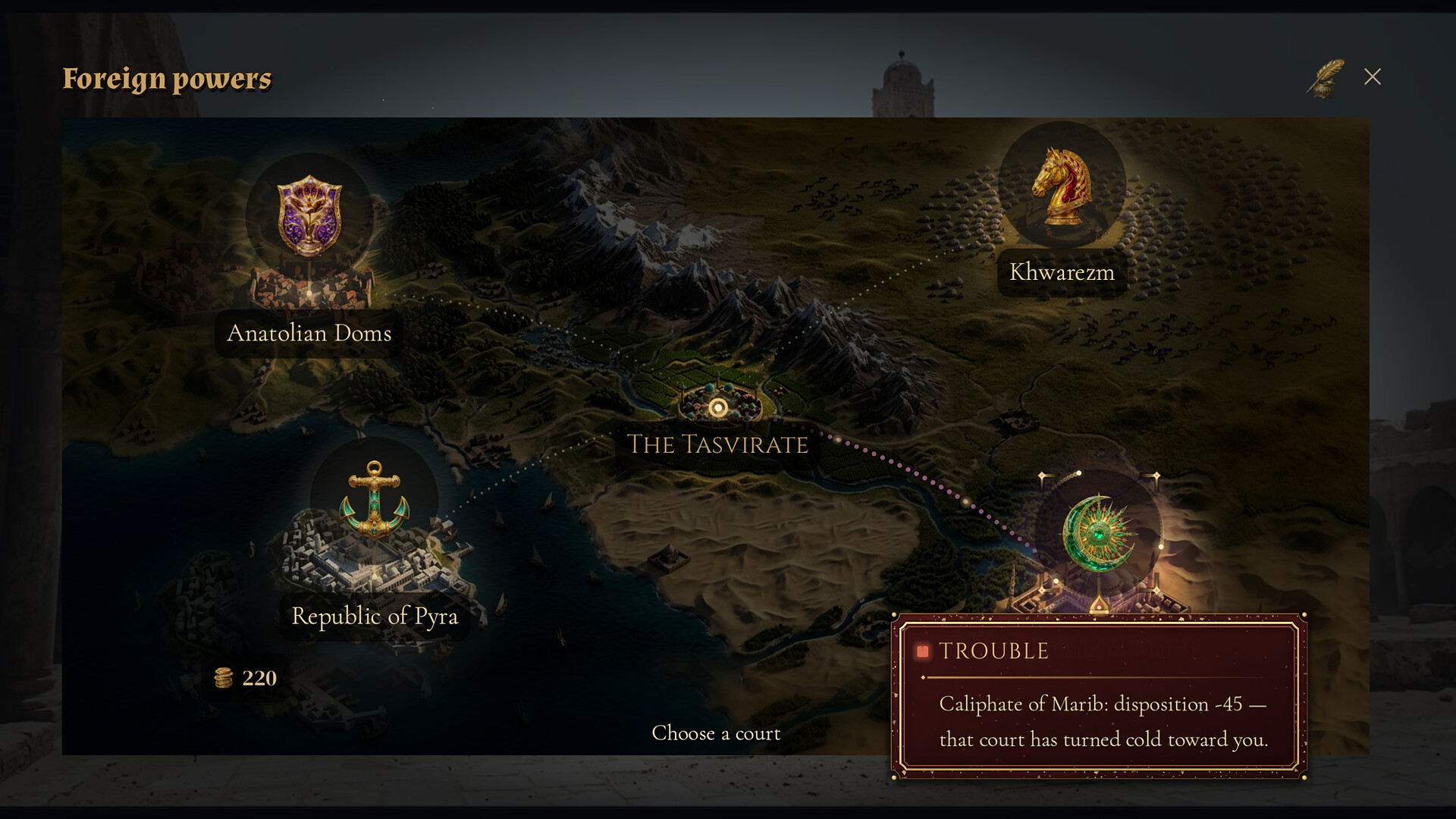
Embassies, fateful letters & the Pact Desk: each neighbouring court's delegation arrives in its own live-action vignette on first contact, embassy cards carry each court's painted treaty sheet, foreign demands and offers cross the map by galley, riders, or caravan under their court's crest, fateful letters crack open under wax to reveal their sender's heraldry, and alliances and royal marriages are held under wax at the Pact Desk.

The Great Seal, the Golden Bull & a harder test for strong viziers: once you have completed a first good service on Normal or Harsh, stand firm in the king's high trust in a later Normal service and he will offer you The Great Seal, raising the service to Harsh rules by your consent — hold it for two years in his favour and he bestows The Golden Bull in a ceremony of its own (with a new Steam achievement). Meanwhile, a rich but unarmed realm attracts greedy neighbours, a dominant vizier draws sharper pushback at court, and when the king tests who truly rules, keeping the seal seats a second voice at his council that makes bending his will harder for two years.

Chronicle in Miniatures, Quiet Moments, a living capital & over thirty new paintings: choose a painted miniature at the turn of each year to keep in your service's chronicle row; meet up to three Quiet Moments as a painting and a single line between seasons; watch the capital skyline in the top bar reflect festivals, mourning, war beacons, and the works completed in your capital province; meet one familiar face at court from your life before the seal; and see new paintings across recurring court events, Audience day outcomes, and winter candlelight.

Re-imagined opening, «The last evening» & End of Service: the opening unfolds one thought per screen with spoken ink and lit emblems; before your final audience, «The last evening» on the terrace lets you lay the seal into its case as the city lights its windows one by one; and the end of service walks cleanly beat by beat onto a redesigned «The reign sheet».

Changes 6

Earlier guidance & clearer stakes (from your feedback): The Vizier's Desk is pointed out in your early years if you have not opened it yet; the first cards of a first service say in one short line what is at stake; faction loans state their exact repayment season and purse cost right on the loan move; and «How to play» now states the aim of a service clearly.

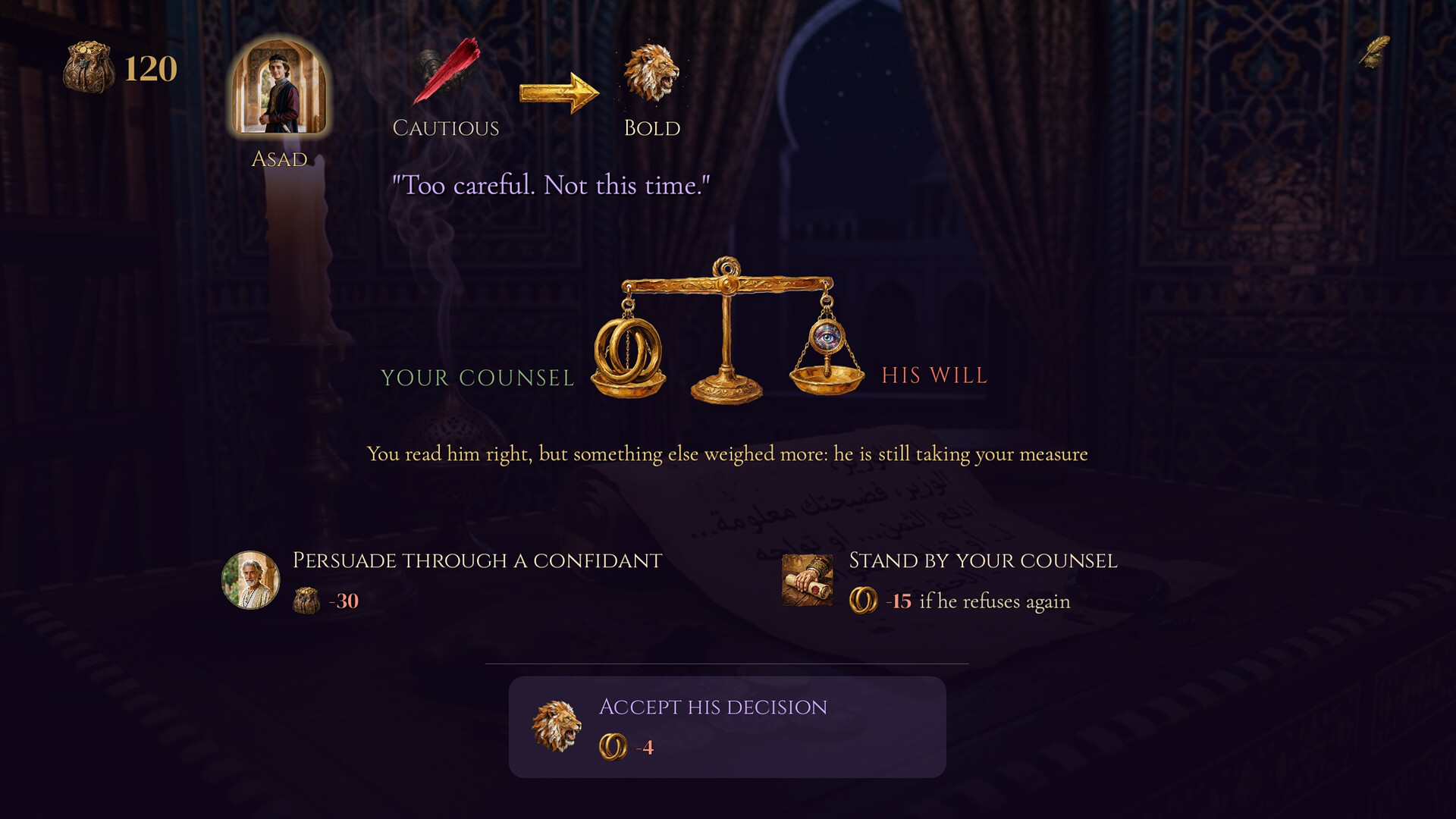
Clearer royal tells: «This tone is not to his liking» now strikes through the disliked tone before your eyes, and when he overrules you, shows your tone crossed out beside his own.

A full treasury & late-reign neighbours answer to real causes, not timers: holding more than 550 drachms in the treasury no longer loses a slice automatically each season — instead, a brimming treasury draws real royal commissions, endowments, and loan requests sooner; and neighbouring courts no longer cool toward you simply because years have passed.

A full year's breathing room after a rival falls: defeating or outlasting a rival now guarantees a full year of court business before the king seats a successor, even when his trust in you is high.

Court envy visible before it strikes: your own dossier now shows the court's growing whisper as your eminence rises, so pushback against a powerful vizier never comes out of nowhere.

«Show the screens' first hints again» in Settings now wears its own painted lamp tile alongside the other interface switches.

Fixes 10

  • Fixed war loans, peacetime tribute accounting, and the yearly calendar rite so realm economy forecasts and seasonal obligations stay exact across war and peace transitions.
  • Fixed coronation and favourite-appointment edge cases so a promoted heir or newly seated courtier never leaves rival or council state inconsistent.
  • A failed autosave (a full disk, a locked or syncing folder) now tells you instead of failing silently.
  • After you have told the king of your affair yourself, a later night together no longer costs trust as if he had just found out.
  • Help, tooltips and the Codex now match the game: faction approval is of you, the stability line is 40, a scheme's choices are named rightly, prices are in drachms.
  • Polish letters no longer break apart on decorative buttons.
  • A new ruler of a neighbouring court now has a face of his own, and an age to match it, instead of wearing his predecessor's portrait.
  • Refined layout, type sizes, legibility grounds, and ultrawide framing across new scenes, dossiers, and refusal scales in all seven languages.
  • Hardened scene transitions, keyboard/controller focus, and background async steps for steadier play over long services; saves from 1.0.2 continue seamlessly.
  • Thank you for helping shape Vizier — keep the reviews and reports coming. Every single one is read.

Source: Steam announcement SteamDB

Patch 1.0.2 — the rival at the king's ear, a new frontier report

Build 26724684
Thank you for playing Vizier and for the reviews — this update answers several of them directly.

New 11

The rival at the king's ear: when your rival's whisper truly costs you the king's trust, a screen now shows it — who told whom, what it cost, which matter was pressed and why the rival's voice carries — and what you can set against it: weaken the rival's influence, or remove the cause.

The report from the frontier, redrawn: it uses the whole width, on dark pages that read well; the raid's road is drawn as a war arrow, the host on your border has its own sign, and what you can do is named as your province's own works.

Someone else's attentions: in a long love, someone at court — or a foreign envoy — may court your beloved, who comes to you first.

A first look at each main screen: the first time you open the Desk, the Court, the Provinces, the Factions or the neighbouring courts, a dark veil lights the two or three places to know, each with a line on what it is for, and burns away once you have read it. “Got it” waits a few seconds, so it is not pressed before the first line is read. It happens once; “Show the screens' first hints again” in the settings brings it back.

The king's first tells: the first time you see him warm to the tone of your counsel — and the first time you see him turn from it — the moment is held: his hand on the throne's arm, the tone named beside its seal, and what you have learnt of how he hears you.

An evening by the brazier: once he has known you a year and trusts you warmly, the king may keep you after the council, the crown off, two cups by the coals — and speak of something other than the realm.

A sheet from your past life: the colleague with your old manuscript, the captain who knew you, the creditor who found you — each now leaves a few lines of his own in the casket on your writing desk.

Nard, as hard as you like: before the evening's first game the king asks how hard to play — as friends, at ease, or in earnest. The dice are as fair as ever; only how closely he plays changes.

The crown passes on screens of its own: when the king dies and you serve on, the empty throne at dawn is held for a moment — and then the new king, crowned, with his first words to you.

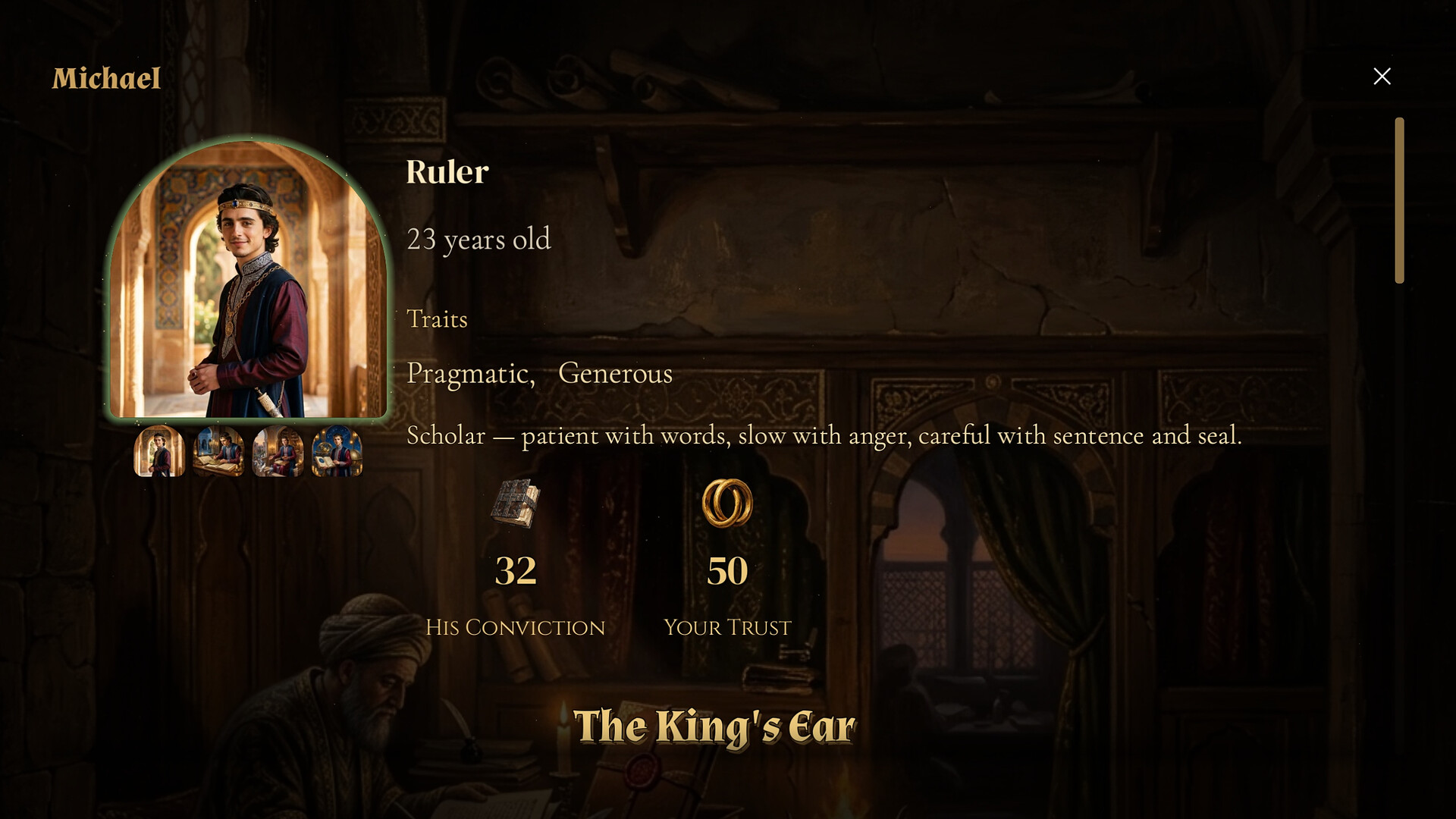
One name for each face: the court you meet wears the same names in every service — the marshal is always Bahram, the heir always Romanos — and each king and each neighbouring ruler has a name of his own, so a second service meets old acquaintances. The townsfolk too: the archive clerk, the night courier and the head cook keep their names, and no stranger you meet shares a name with the court.

New paintings: three more for the decisive battle and a family of eleven for sieges; new and second paintings for the cards you meet most — the faction's suppers, the king's jubilee, the treasury, the unfinished question of the succession, the throne in all but name; six more for war — the council over the map, the courier at the gate, the mountain pass, the ford, the return home, the valley ploughed again; more for the letters, the king's fears, the jubilee and the unravelled plot; fifteen more for the love story, five for each couple; a building icon for works.

Changes 18

  • Every card reads faster, in all seven languages: each answer fits on one line, so the answers' type stays large; answers no longer wear quotation marks — they are your decisions, not citations; each is written in each language's own idiom, and the situations and outcomes of the cards you meet most are shorter and livelier — same story, fewer words.
  • What comes again is told again in other words: a courtier's request is answered in new words each time round, a court's second and third letters wear their own titles, and another province's delegation speaks for itself.
  • The king weighs his trust every season, not once a year — and a whisper about something he has already heard costs you less the second time.
  • A hint that points somewhere shows the way: a card that hints at a move — investigate a courtier, train your protégé, pay court — now shows where to go and what to press: the place's door and the move's emblem, large, joined by a golden path.
  • “The last council” shows the king's seal beside his face — taken warmly, taken, taken coolly, refused or overruled.
  • What a planted idea costs is named in the ledger — “The price of a planted idea: he dimly feels he was led” — and its hints call it by the codex's name.
  • The plot against you is “The thread of a plot” on its page, and its lines speak of a plot uncovered.
  • The frontier report's tiles say only what their titles do not, in larger type; Marib's sermons and an old cold have signs of their own.
  • Your protégé: when your protégé is sent to govern a province, the card now says so, and the portrait carries the mark of your lessons.
  • An old favour called in: its answers now name what is actually asked — the clerkship, the post at the gate, the hearing.
  • The diary opens on its own painted study — a candle, the clasped journal, a kilim over the chair — in place of a looping video of another century's room.
  • “What changed — and why” reads shorter: the same income from several provinces is one line that names them all, and the same words stand as one line with their count; a faction's loyalty says what it brought you.
  • How the rival's design came out no longer takes a season of its own: it is told in its season, and the season's business comes after it.
  • The late years keep their seasons: small household moments no longer come in the last two years of a service; the horse's last ride, three memories with the king and the old petitioner no longer take a season.
  • Your beloved's evening calls are spread over the years of your bond instead of crowding its first ones.
  • Twelve small answers that promised something now do it — the tinker is paid from your purse, the talking bird goes to a court, the glove and the unsigned letter to your spymaster, the edicts to their province, the niece's afternoons to the treasurer, the old warhorse leads the review, the tutor's notebooks are read, the poet gets his purse, the bell rings for the poor quarters too — each with its hint.
  • Our own realm is Tasvirat in every language, without an article.
  • Translations, line by line: in German, Spanish, Polish, French, Portuguese and Russian, more than a thousand lines that followed English word order or idiom were rewritten the way the language says it — and a few real mistakes went with them: in Portuguese the king turned *to* you instead of away; in Spanish, French and Portuguese a neighbouring realm wore the name of the coalition of courts set against you — and in Russian the coalition is now «Сговор», no longer confused with the Anatolian Doms.

Fixes 13

  • Some answers you give before the king — owning up when the rival accuses you, answering the council's critic, the captain's nickname, a ruling for those the quarrel tramples — were judged twice: by the answer's own outcome and again by his regard. Now once. His regard of an answer given before him is written in the ledger as an answer he heard, not a rite he watched.
  • An old cat was remembered even when you had not kept one.
  • A save from before an update could keep showing an old painting on a card (the siege wearing the cavalry battle).
  • œYour word, come due” was hard to read in French — rewritten in all seven languages.
  • In French and Portuguese, the reply to the rival lost a choice in the last update.
  • A court's letter could show another court's envoy; it now shows its own court's, or one any court might send.
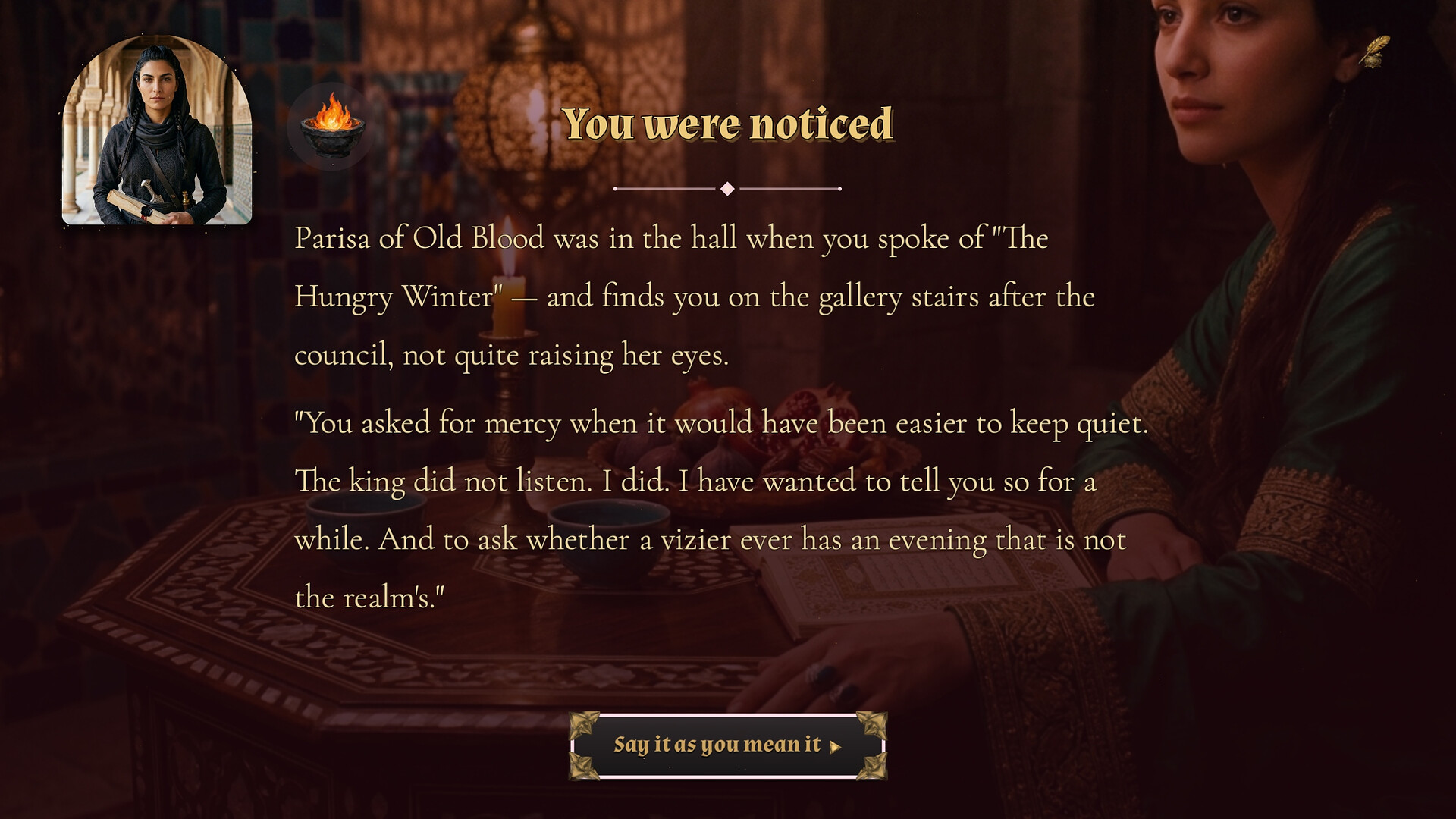
  • A few paintings showed a man where your rival is a woman, or the king's face beside his own portrait — repainted, the king now seen from behind; “You were noticed” by a man shows his garden; the ultimatum no longer shows the assault while the envoy is still in the hall.
  • The answers to the end of the rival's design now say what their outcome says, and a demand's fourth answer records its own reason in the ledger, court by court.
  • Four answers now say what their outcome does: the levy called to the marches, the walls at the fords, the drill at the fort, the charmer refused coldly.
  • The flatbread seller at the gate has a new portrait, with pictures of her at work in her dossier.
  • Long services use less video memory.
  • Small seams in the text: the note pinned to your release, a second province breaking away, and many more in all seven languages.
  • Thank you — keep the reports coming. Every one of them is read.

Source: Steam announcement SteamDB

Reviews and comments

Write a post

Rate this game
0 / 1000

Stars make your post a review; without them it stays a comment.

Please follow our community standards. Read the community rules